Class
Family
Genus



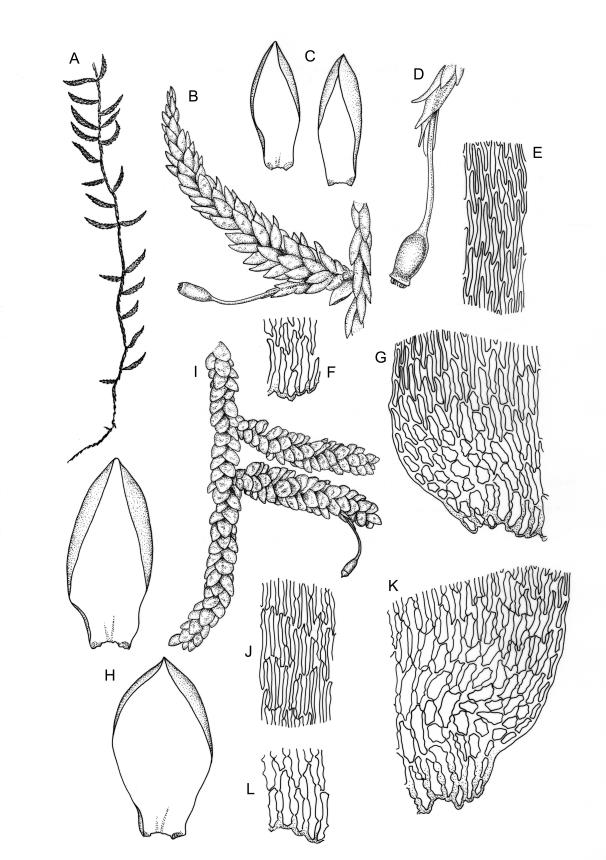
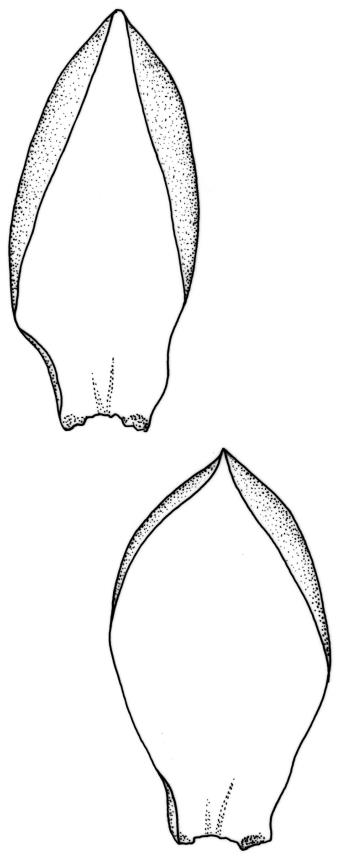
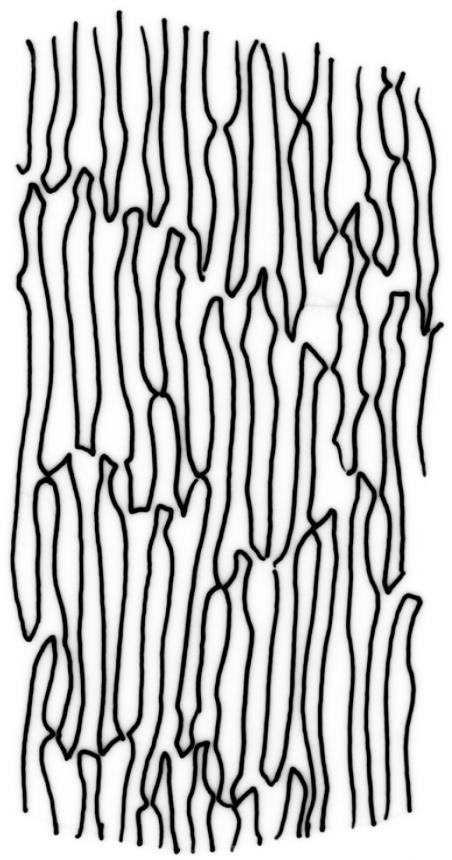
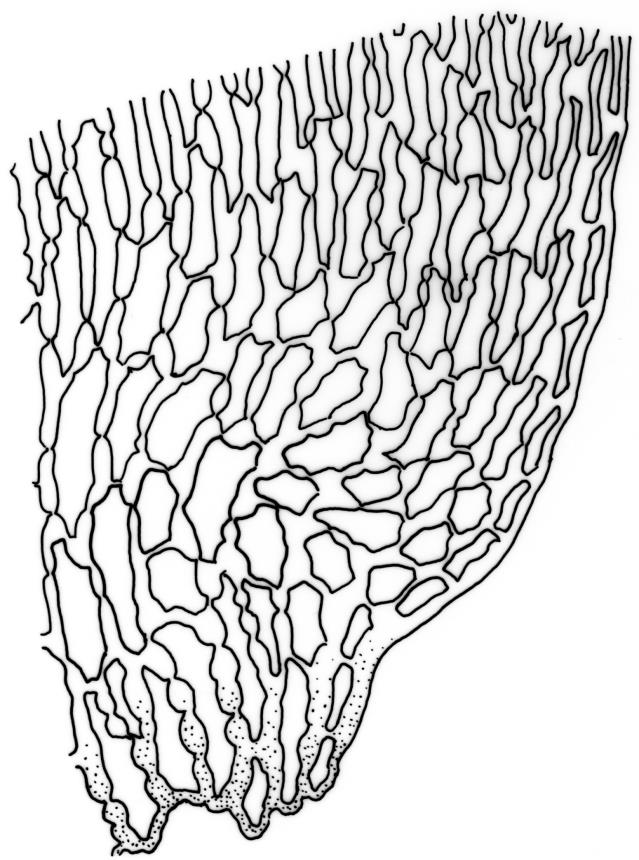
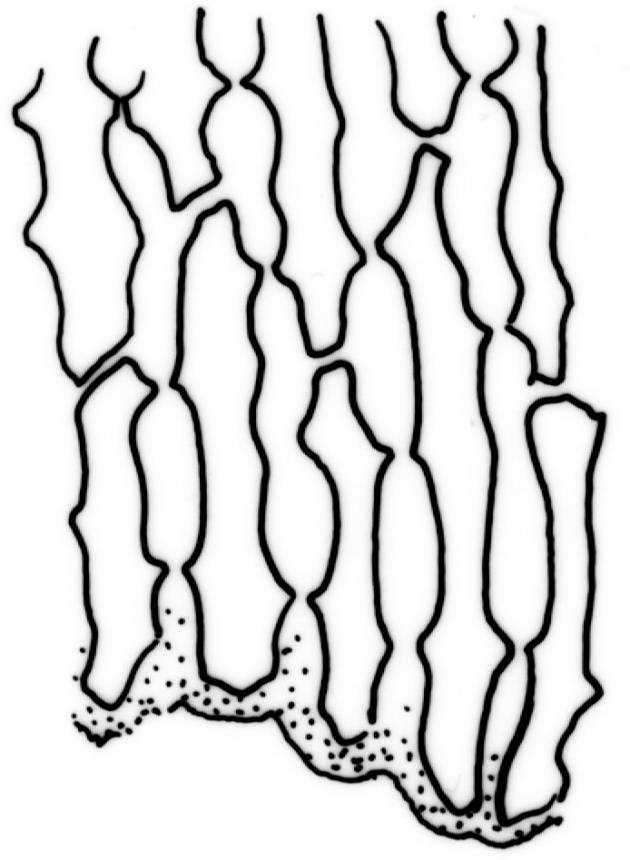
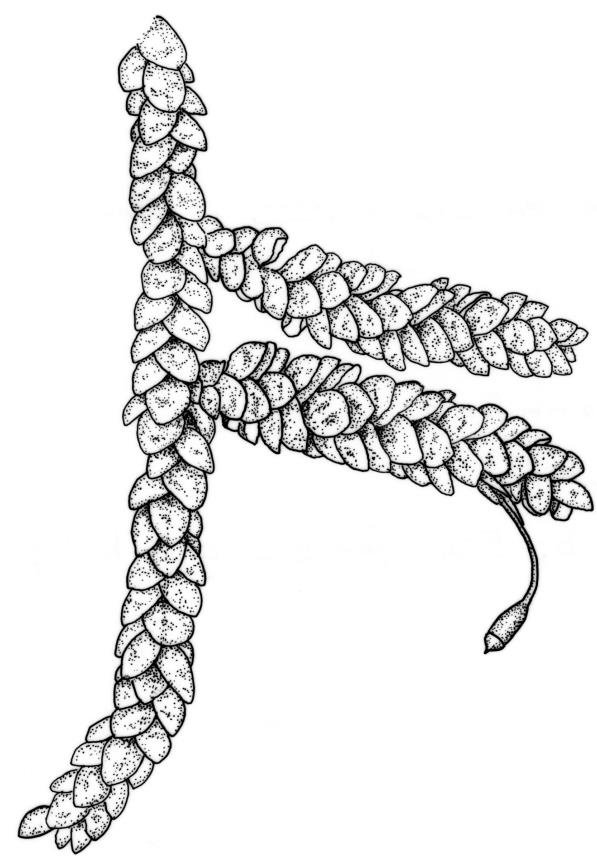
Plants robust, soft, light to dark olive-green to brown-green, dull or slightly glossy, forming wefts or pendent masses on bark, rocks and rotten logs, rarely on the ground. Stems prostrate-scrambling to pendent, sometimes ± erect, sometimes subdendroid, tumid, bluntly cuspidate to attenuate; in cross-section c. 280 × 220 µm with an outer layer of c. 5 cells surrounding a core of parenchyma and an indistinct central strand. Branches loosely cuspidate, sometimes abruptly and multiply flagelliferous with microphyllous shoots. Pseudoparaphyllia c. 250 × 200 µm. Stem leaves imbricate, erect to erect-spreading, smooth when moist, loosely wrinkled when dry, widely ovate to oblong, obtuse or widely acute, very concave, with the apex erect, ± entire, 2.1–2.3 × (1.3–) 1.4–1.7 mm, with alar cells irregularly walled, porose, to form a dark group 10–13 cells wide and extending 5–6 cells from the leaf base. Branch leaves loosely imbricate, sometimes more widely spreading than stem leaves, ± shorter and narrower, (0.6–) 0.8–0.9 (–1.0) × (0.4–) 0.5–0.6 mm, with a smaller alar group, 8–9 cells wide and 4–5 high. Mid laminal cells of branch leaves linear, weakly sinuous, thick-walled, prorate, porose, (38–) 43–57 (–67) × 2.4–3.6 µm; becoming wider and thicker-walled towards the central base, 4.8–7.2 µm; apical cells rhombic-sinuous, (4.8–) 10–21 (–48) × 2.4–4.8 µm.
Dioicous or pseudautoicous. Setae short and stout or elongate, (5–) 10–12 or 15–20 mm, sometimes loosely twisted to the left in longer forms. Capsules oblong-cylindric, (1–) 1.6 × 0.7 mm; exothecial cells irregularly oblong to ± quadrate, c. 30–36 (–43) × 19–24 (–29) µm. Operculum symmetric, blunt to apiculate, occasionally rostrate, to 0.8 mm. Exostome teeth 520–550 µm long; endostome with a basal membrane c. ½ the height of the exostome, with 2–3 cilia. Calyptra c. 3 mm. Spores 17–24 µm.
Sainsbury 1955, pl. 56, fig. 1.
Weymouthia cochlearifolia is a quite variable plant. It is typically robust and weft forming, with thick ± tumid stems and branches, and deeply concave, widely ovate leaves that are often neatly spirally arranged. Its stems and branches are cuspidate, sometimes attenuate, and occasionally rhizoidal at the tips. More rarely, plants are flagelliferous from filiform shoots developing distally on branches. Creeping stems are sometimes stoloniferous, with leaves between the branches closely pressed to the stem or very reduced. Creeping stems can also become pendent to produce elongate growth, with widely spaced lateral branches.
This elongate growth in W. cochlearifolia has a parallel in W. mollis, where the leaves along the main stem contrast with those of the branches. In the latter, the main stem leaves are more closely pressed to the stem than the branch leaves which are more widely spreading. This makes the main stems narrower than the branches, echoing the stoloniferous growth of the creeping and pendent main stems of W. cochlearifolia.
Despite this variability, the combination of robust, relatively soft, green-brown wefts of thick erect branches makes W. cochlearifolia readily recognisable. It is most commonly confused with Camptochaete arbuscula, which is, typically, a wiry plant with much branched fronds supported on unbranched stipes. However, the variability of both can produce similar forms that are difficult to separate. Camptochaete arbuscula can have tumid branches, but its leaves are more usually complanate or subdistichous and this feature is usually evident in elongate growth. Both have leaves which are somewhat glossy and wrinkled when dry, concave and widely acute. Weymouthia cochlearifolia differs in having leaves more deeply concave and wider than C. arbuscula. Both have the same cell pattern of elongate mid-laminal cells, shorter apical cells and differentiated alar cells, but mid-laminal cells in W. cochlearifolia are more strongly porose, and this can be quite a marked feature. In fertile plants, there can be overlap in the length of setae, but the erect inner perichaetial leaves of W. cochlearifolia are diagnostic. The operculum varies from apiculate to rostrate in W. cochlearifolia, but it is always apiculate in C. arbuscula. Camptochaete arbuscula var. tumida may be confused with W. cochlearifolia in its loose branching and tumid stems, but it differs in being a more wiry plant and in having a distinct leaf apiculus lacking in the latter.
Weymouthia cochlearifolia has been confused with Lembophyllum spp., particularly L. clandestinum, and the main differences have been outlined above. The cell pattern in Lembophyllum is distinctive amongst the N.Z. Lembophyllaceae and is diagnostic in identifying W. cochlearifolia in cases where variability of growth form makes separation difficult.
NI: N Auckland, including offshore islands (PK, HC, LB, GB, RT), S Auckland, Gisborne, Hawke’s Bay, Taranaki (Taranaki Maunga), Wellington; SI: Nelson, Marlborough, Canterbury, Westland, Otago, Southland; St; Ch; Sol; A; C.
Austral. Tasmania*, mainland Australia (Vic.*); Chile*.
Weymouthia cochlearifolia forms robust wefts and pendent fronds on a range of substrates including bark, rocks, logs and soil, tree fern trunks and exposed roots in a wide range of habitats. It occurs from lowland forest floor and stream beds to more open and upper elevations where it can be epiphytic on small twigs. It occurs close to sea-level in Westland (Lake Matheson and Pororari River) and Southland (Dusky Sound) on the South I., and it is most commonly found from 100 m to 800 m; up to 1000 m in Abel Tasman National Park (Mt Evans) on the South I., and to 1200 m on the North I. (Mt Ruapehu).