Class
Family
Genus



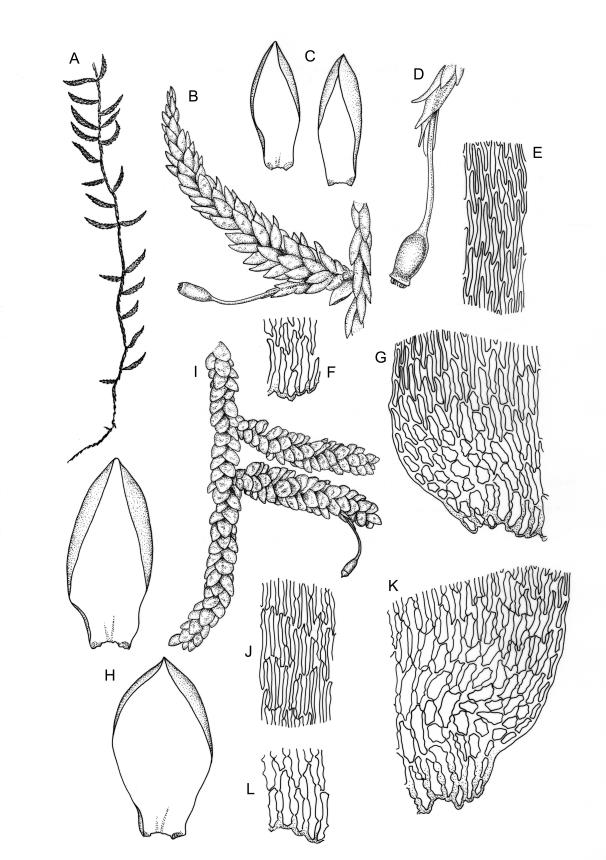
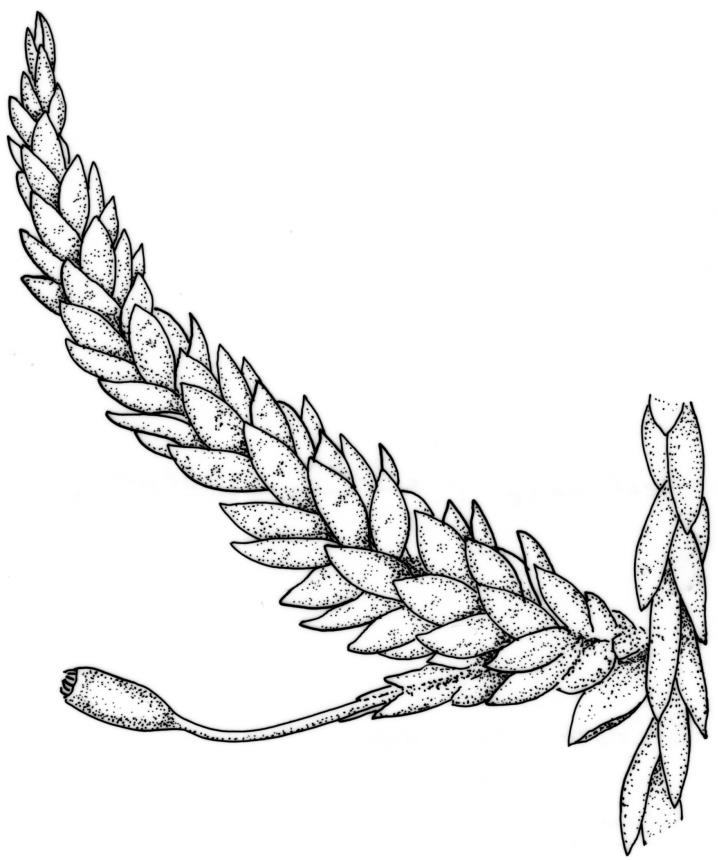
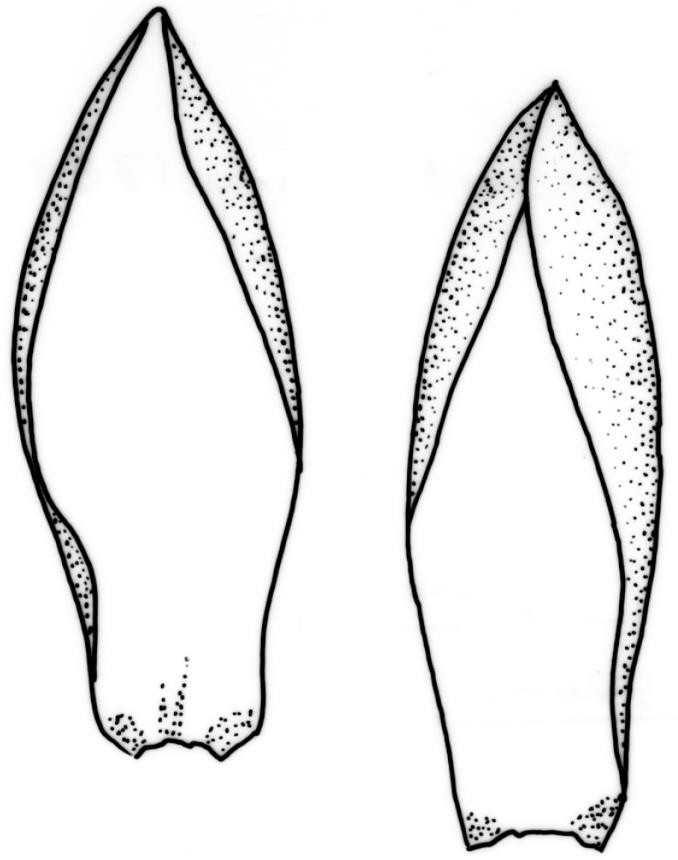
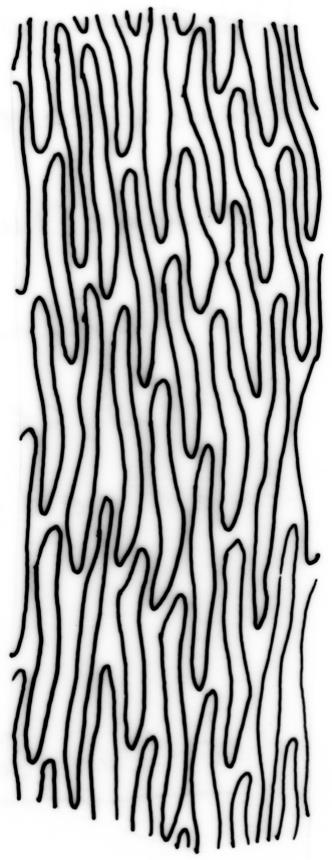
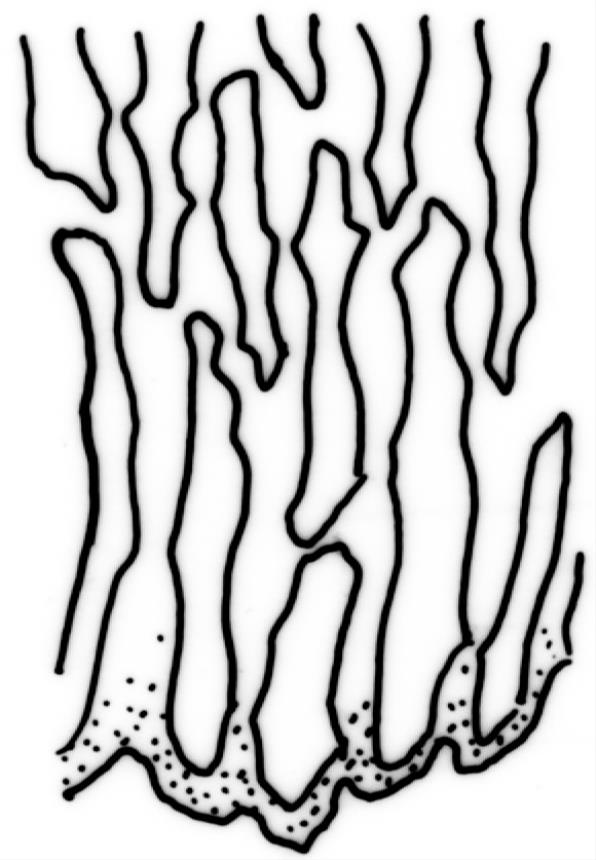
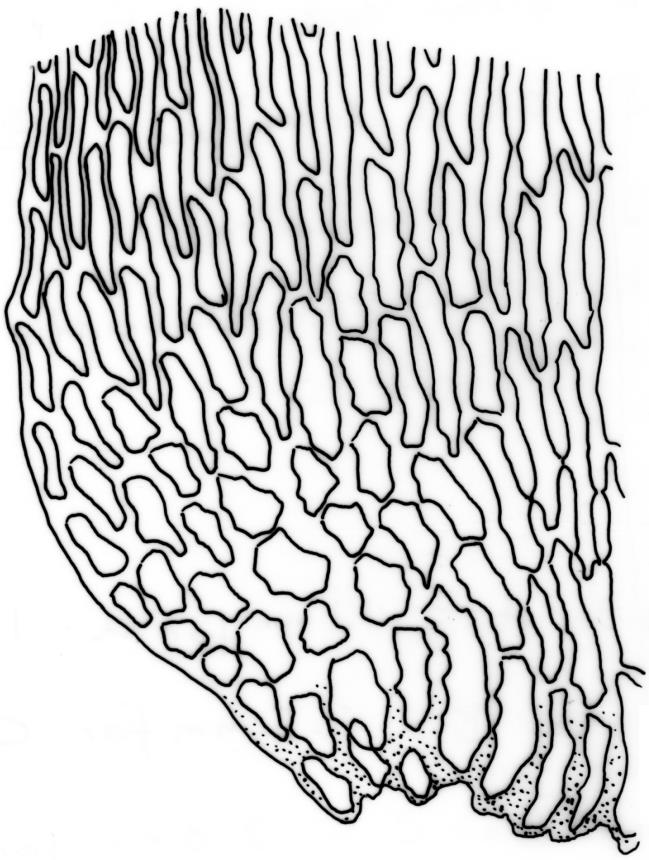
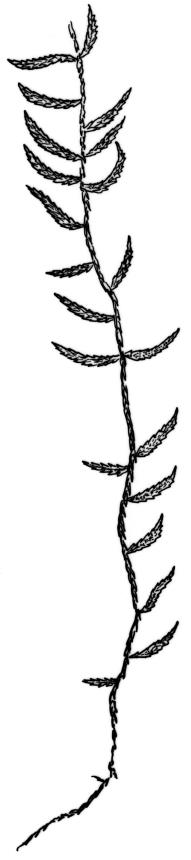
Plants slender, light to dark olive-green, slightly glossy, forming extensive loosely attached masses on shrubs and trees. Stems pendent or sometimes creeping, loosely complanate, attenuate, not stipitate; in cross-section ± round, 230 × 190–210 µm, with an outer layer of 4–5 cells surrounding a core of parenchyma and an indistinct central strand. Branches wider than stems, cuspidate, sometimes attenuate. Pseudoparaphyllia c. 200 × 125 µm. Stem leaves erect, imbricate, inflated-smooth when moist, loosely wrinkled when dry, oblong, obtuse to widely acute, erect at the apex, denticulate above and occasionally to the lower margins, 1.5–1.7 (–1.8) × 0.6–0.7 mm, with alar cells thick-walled and irregularly porose, forming a dark excavate group 5–6 cells wide and extending 5–6 cells from the leaf base. Branch leaves shorter, erect-spreading, with a smaller alar group, 1.2–1.5 × 0.6–0.7 mm. Mid laminal cells of branch leaves linear, ± sinuous, firm-walled, prorate, not porose, 40–50 (–60) × 2.4–3.2 µm; becoming somewhat shorter, wider and porose towards the base, (24–) 36–55 × 3.2.–4.8 (–6.4) µm, at the apex rhombic, 5–12 (–28) × 3.6–4.8 µm.
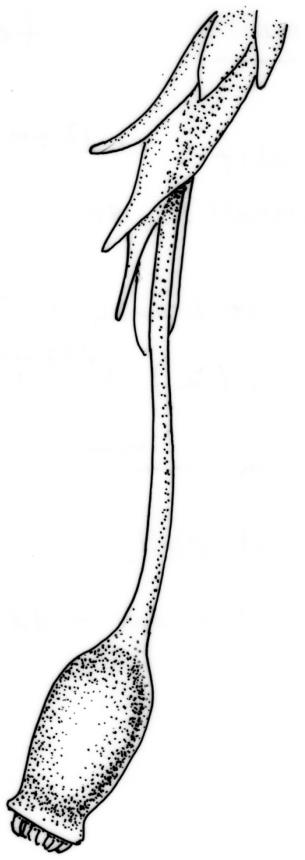
Dioicous or pseudautoicous. Setae short, to c. 3.5 mm, not twisted. Capsules oblong, (0.9–) 1.0–1.2 × 0.6–0.7 mm; exothecial cells irregularly rectangular to hexagonal or ± isodiametric, 30–38 (–50) × (14–) 26–30 µm. Operculum rostrate, 0.5–0.9 mm. Exostome teeth 325–35 µm long; endostome with a basal membrane c. ⅕ of the height of the exostome. Calyptra c. 2 mm. Spores 28–33 µm.
Weymouthia mollis is a comparatively slender plant that is always pendent and lacks a weft-forming habit. It differs from W. cochlearifolia in a number of features, principally in growth form and cell structure, and it is the only member of the N.Z. Lembophyllaceae which consistently produces pendent fronds. The other species, W. cochlearifolia, is mostly weft-forming, but does frequently produce pendent fronds. The mid laminal cells of W. mollis are non-porose, contrasting with the cells of W. cochlearifolia which are strongly porose. Sporophytically, the two taxa differ in several respects. The operculum of W. cochlearifolia is variable, apiculate to rostrate, compared to the rostrate operculum of W. mollis, and the endostome of W. mollis is reduced. The calyptra of W. mollis may rarely be sparsely hairy, a feature absent in the other species.
As noted above, the pendulous forms of Weymouthia mollis are similar to species of Papillaria which differ in a range of features including plant colour, leaf plication and costae, a lack of alar cells and papillose cells.
NI: N Auckland, including offshore islands (PK, HC, LB, GB), S Auckland, Gisborne, Hawke’s Bay, Taranaki (Taranaki Maunga), Wellington; SI: Nelson, Marlborough, Canterbury, Westland, Otago, Southland; Ch.
Austral. Tasmania*, mainland Australia (Vic.*); Tahiti*; Chile*.
Weymouthia mollis typically forms pendent masses on twigs and small branches in humid forest habitats, particularly over streams and river margins. It also occurs on damp logs and rocks. It mainly occurs in forest, particularly upper elevation forest, and also grows in more open and shaded shrubland. It occurs close to sea-level at Riccarton Bush, Christchurch, but mostly from 60 m to 800 m across much of its range. It is known up to 1100 m in Abel Tasman National Park on South I., and to 1200 m on North I. (Pihanga,Taupo).