Class
Family



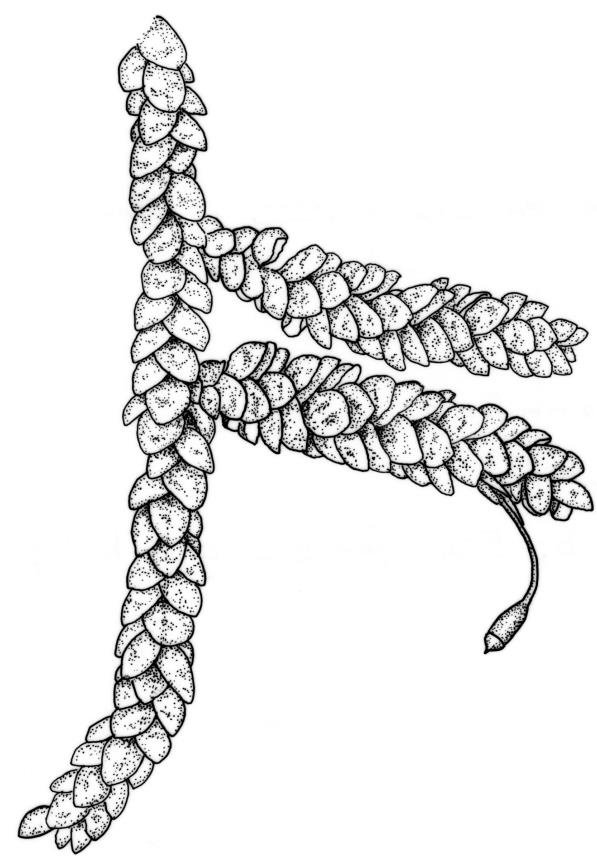
Plants robust or slender, soft, light to olive-green or brown-green, dull to glossy, forming wefts or pendent masses on trunks of trees. Stems creeping to erect-ascendent or pendent, sometimes stipitate, mostly complanate to neatly julaceous. Branches frequent or sparse, simple and erect from creeping stems, or lateral from pendent stems, sometimes forming ± regular complanate fronds, sometimes flagelliferous. Pseudoparaphyllia foliose, widely oblong and irregularly serrate. Stem leaves erect or erect-spreading, imbricate, loosely collapsed-wrinkled when dry, inflated smooth when moist, moderately to deeply concave, ovate to oblong, obtuse or widely acute, erect at the apex, ± entire or denticulate above and occasionally to lower margin. Costa double and failing below mid leaf, faint or absent. Mid laminal cells linear, ± sigmoid, firm- to thick-walled, porose or not, prorate; towards the leaf base shorter, wider, more irregular, thicker walled and usually porose to form a weak basal band; those above shorter, rhombic and thick-walled at the apex. Alar cells pigmented and forming a distinct group of smaller, isodiametric to short-rectangular cells which contrast with adjacent laminal and basal cells.
Dioicous or autoicous. Inner perichaetial leaves erect, sheathing, lanceolate, acuminate, ecostate, unbordered. Setae short or elongate, red-brown flexuose, smooth. Capsules exserted, smooth, horizontal, symmetric, oblong and weakly constricted below the mouth when dry; exothecial cells irregularly oblong to quadrate and firm- to thick-walled, with several rows of smaller, isodiametric cells below capsule mouth. Exostome teeth pale yellow-brown to hyaline, lanceolate, shouldered, with a zigzag median line; outer surface cross-striate below and papillose above, inner surface lamellate, smooth; endostome pale yellow-brown to hyaline, papillose, with a basal membrane c. (⅕–) ¼–½ of the exostome; with segments equal to the height of the exostome, keeled, perforate, cilia present or absent. Calyptra narrowly cucullate, smooth and enclosing the entire capsule, sometimes with 2–3 hairs at the base. Operculum symmetric and apiculate or asymmetric and rostrate. Spores spherical, pale yellow-brown, papillose.
A genus of two species, both of which occur in N.Z.
Buck (1994, p. 70) designated W. mollis as the type of Weymouthia.
The genus has been placed in the Meteoriaceae, a mostly tropical family with epiphytic, pendent growth forms that Weymouthia also exhibits. W. cochlearifolia was treated by Brotherus (1901–1909) as both W. billardierei in the Meteoriaceae and as Lembophyllum cochlearifolium in the Lembophyllaceae (Dixon 1927). Dixon (1927) treated Weymouthia in the Neckeraceae, but also noted similarities to the Lembophyllaceae. Subsequent authors have treated Weymouthia either in the Meteoriaceae (Sainsbury 1955; Scott & Stone 1976; Streimann 1991; Beever et al. 1992; Buck 1994), or in the Lembophyllaceae, the latter on both morphological (Tangney 1997) and molecular grounds (Quandt et al. 2000; Quandt et al. 2009; Enroth et al. 2019), and this placement is followed here.
| 1 | Plants slender usually pendent; stems complanate, with leaves not neatly spiralled; mid laminal cells not porose; endostome reduced, with a low basal membrane and cilia lacking | W. mollis |
| 1' | Plants robust erect or pendent; stems tumid, with leaves often in neat spirals; mid laminal cells porose; endostome well developed, with a basal membrane ½ the height of the exostome and 2–3 cilia. | W. cochlearifolia |
The two species of Weymouthia share a growth form of predominantly simple lateral branches from a main or primary stem. In W. cochlearifolia lateral branches are mostly erect, produced from a creeping primary stem, and form relatively robust wefts. Pendent shoots are formed as elongate extensions of the creeping stems. In W. mollis the main stems are pendent, with only shortly attached creeping parts, and the lateral branches are widely spreading. The plants form extensive tangled masses usually only lightly attached to twigs and branches of trees and shrubs. Both species have erect sheathing inner perichaetial leaves, while the other N.Z. Lembophyllaceae have squarrose to spreading inner perichaetial leaves.
Both Dixon (1927) and Sainsbury (1955) noted that spores in Weymouthia are larger than the other NZ Lembophyllaceae, reporting spore size in the range of 20–30 µm for both species. While W. mollis produces spores up to 33 μm, almost twice the size of spores in the other species, in W. cochlearifolia spores are smaller, from 17–24 μm.
| Category | Number |
|---|---|
| Indigenous (Non-endemic) | 2 |
| Total | 2 |