Class
Family
Genus



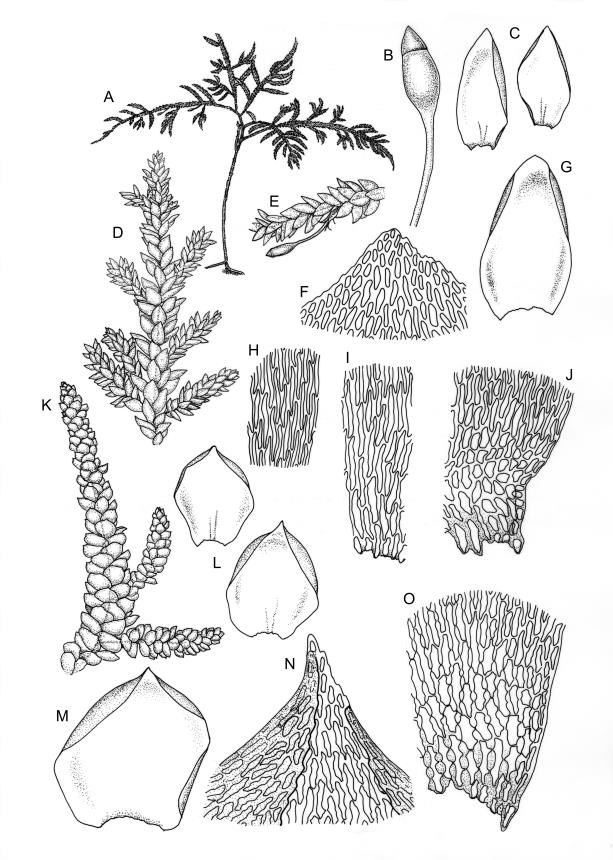
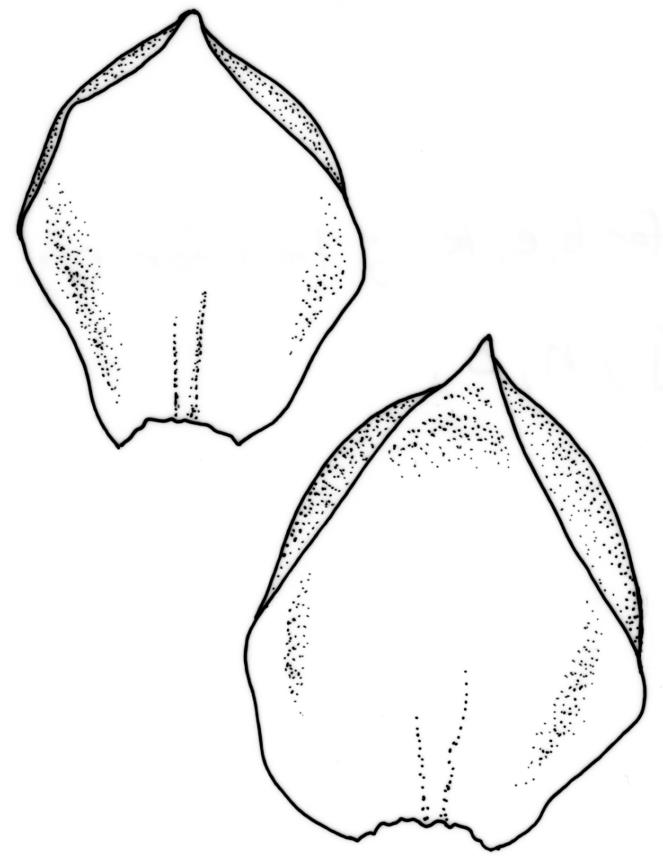
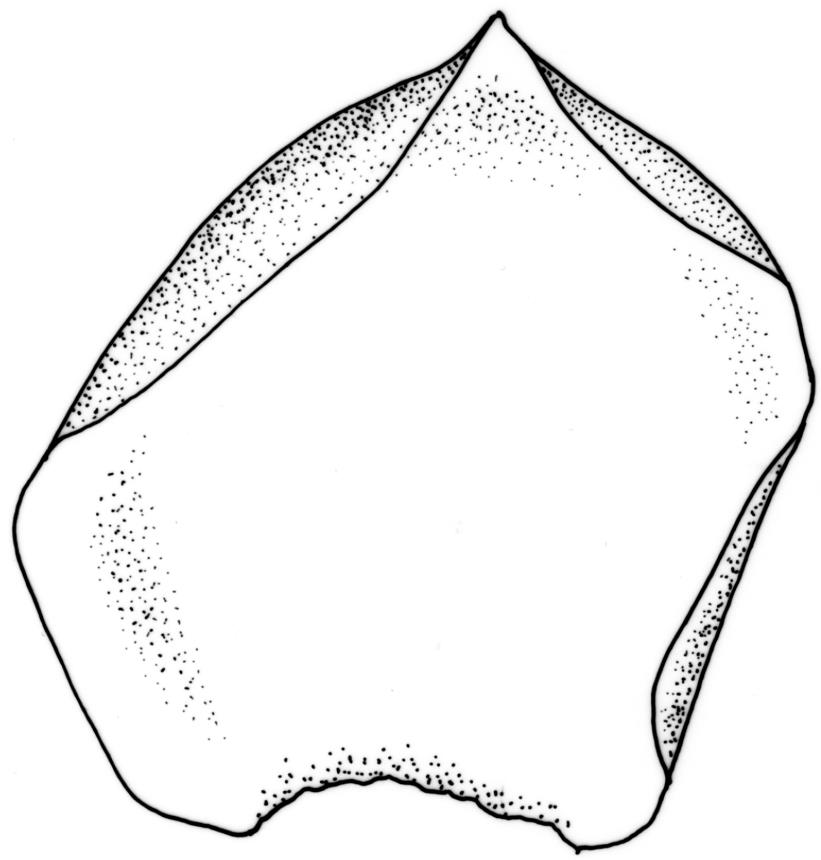
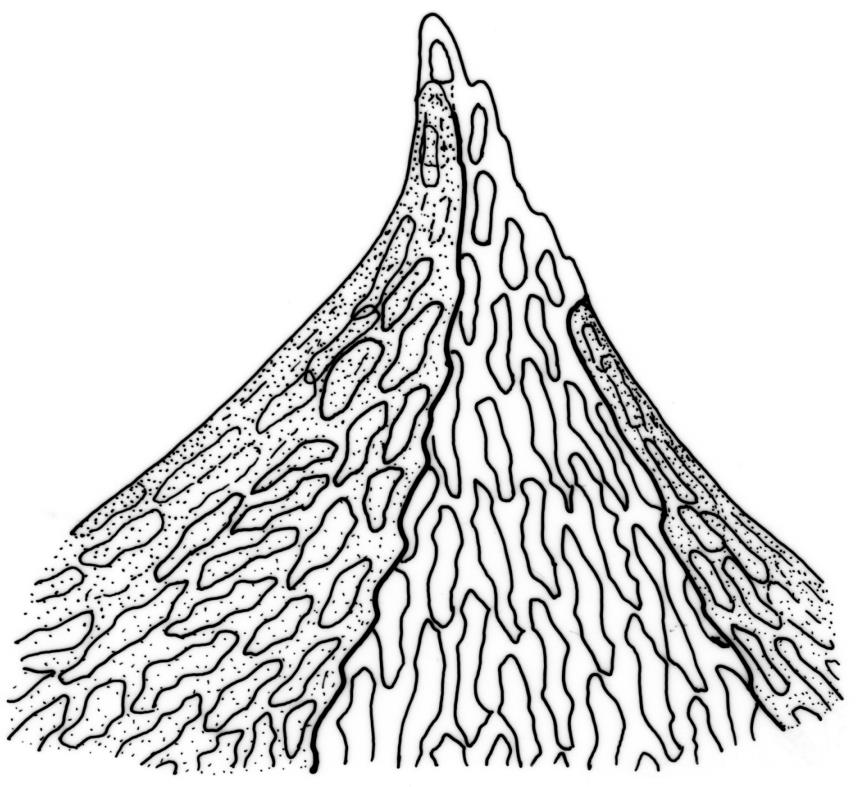
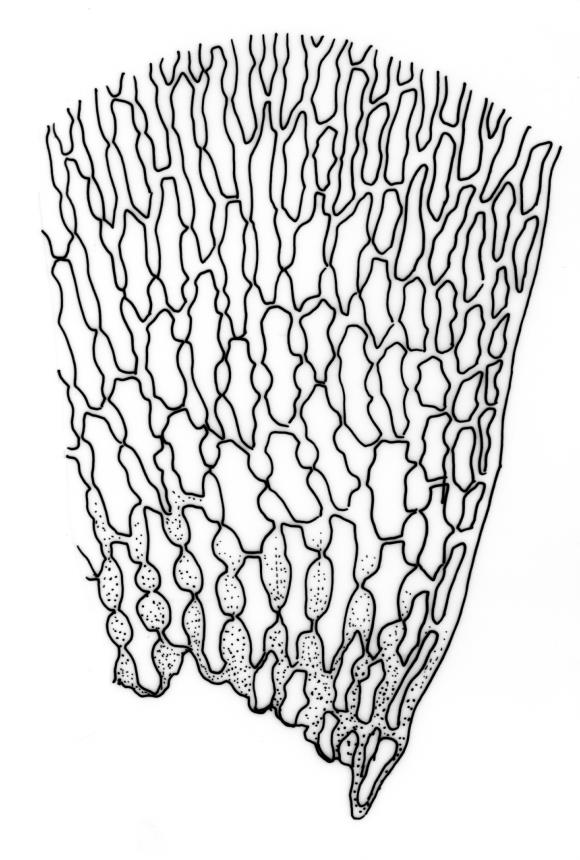
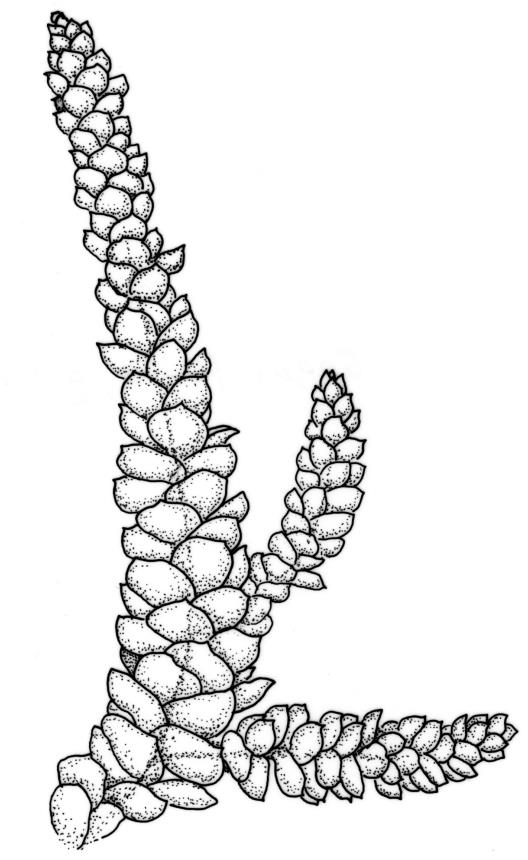
Plants 30–60 mm tall, green to brown-green. Fronds loosely 1(–2)-pinnate. Stipes 15–20 (–30) mm. Branches curved, swollen, loosely julaceous, attenuate and loosely cuspidate. Frond axis leaves regularly imbricate, deeply concave, very widely ovate to oblong, often becoming ± cucullate above, obtuse, with an abrupt erect mucro, 2.0 × 1.3 mm, entire. Branch leaves arranged in neat catenulate spirals 0.8–1.0 × 0.5–0.7 mm. Mid laminal cells 40–50 × 4–5 µm; those above (at extreme apex) 10–15 µm; alar cells forming a group c. 4 cells wide and extending 6 cells from the leaf base.
Setae 8–13 mm. Capsules held above the frond, horizontal, 2.0–2.2 × 1.0 mm; exothecial cells mostly 42–52 × 15–20 µm. Exostome teeth c. 600–650 µm long and inserted c. 70 µm below the mouth.
Tangney 1997, figs. 15, 18.
The more loosely branched fronds, julaceous frond axes and branches, longer branches, distinctly mucronate leaf apices and longer setae distinguish this variety. The plants are similar in size to typical var. arbuscula, but tidier in appearance. The frond axis and branch leaves are in neat spirals, with markedly mucronate apices. They are little altered when dry, ± round and very deeply concave, giving the axes a swollen appearance. The capsules are borne above the fronds.
Some populations of the var. arbuscula may have subjulaceous branches and mucronate leaves, but these differ characteristically from the var. tumida in being more densely branched, with the frond axes and branches not so uniformly swollen, and with leaves less concave, and only weakly mucronate.
SI: Nelson (Nelson Lakes, Mt Arthur, Murchison), Marlborough (Pelorus Bridge), Westland (Kelly's River), Canterbury (Rockwood, Okuku Pass, Mt. Richardson), Otago (Paradise, Kingston, Blue Mts, Otanomomo, Herbert Forest), Southland (Waikaia Valley, Lake Monowai).
Endemic.
Found on the ground and humus over rocks, the trunks and exposed roots of trees, in mostly edge habitats in lowland forest. It is also found in wetter areas, on the ground and silty tree bases near lake shores and rivers, and depressions with standing water (as at Lake Monowai, eastern Fiordland) and may extend to open higher elevation forests (as in the Cobb Valley, Nelson). Altitudinal range: from less than 100 m (Otanomomo, Herbert Forest, Pelorus Bridge) to 940 m (Mt Mytton, Nelson LD).