Class
Family



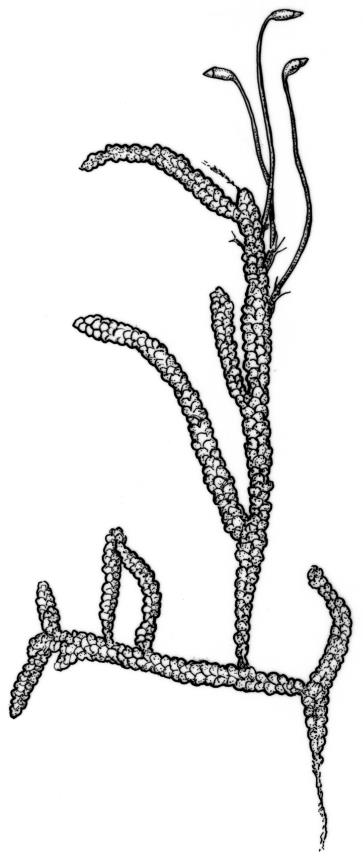
Plants robust, firm to rigid, light olive-green to brown-green or red-brown, dull; forming loose wefts or mats on trunks of trees, exposed roots and rocks. Stems creeping to erect-ascending, mostly stipitate, sparingly 1(–2)-pinnate, forming loose irregular fronds, julaceous to subcomplanate. Branches sparing to frequent, often curved, bluntly cuspidate. Pseudoparaphyllia foliose, widely oblong and irregularly serrate. Leaves regularly imbricate or sometimes distant, ± catenulate, smooth when moist, loosely wrinkled, sometimes weakly striate, or not altered, when dry, deeply concave, orbicular to widely ovate, auriculate, mostly cucullate or, rarely, erect at the apex, obtuse to widely acute; margins incurved, sometimes denticulate to the lower margin. Costa variable, short, double and faint, absent, or single, robust and extending to the upper lamina. Mid laminal cells linear to rhombic, not or weakly porose, thick-walled, moderately prorate; those above rhombic, at the extreme apex short-rhombic, those below irregularly rectangular, at the lateral and basal margins linear-rhombic to ± quadrate. Alar cells pigmented or not, forming a small group weakly differentiated from the adjacent basal margin, quadrate to irregularly so, porose or not.
Pseudautoicous or dioicous, with male plants in leaf axils on the lower parts of fruiting plants, or, more rarely, with gametangia axillary on lateral branches and main stems. Inner perichaetial leaves with apices reflexed from an oblong sheathing base, widely acute to obtuse or with a short mucro. Setae elongate, flexuose, smooth, red-brown. Capsules horizontal, smooth, symmetric or curved, oblong-cylindric (3–4:1), red-brown; exothecial cells mostly oblong, sometimes quadrate, thick-walled. Stomata absent. Peristome diplolepideous; exostome teeth lanceolate, lacking a distinct shoulder, bordered below, pale yellow-brown, outer face striate or striate-papillose below and finely to coarsely baculate above, bullate at the apex, with a zigzag median line; inner face with well-developed lamellae, smooth below, and baculate above; endostome yellow or hyaline, finely baculate to bullate; with the basal membrane c. ¼–½ the height of the endostome and with segments keeled and perforate-cracked, finely baculate to bullate. Cilia 2–3, well developed, nodulose to appendiculate. Operculum blunt to short-rostrate from a high conic base, asymmetric or ± symmetric. Calyptra smooth. Spores spherical, pale yellow-brown, coarsely baculate.
The tendency of species in the Lembophyllaceae to produce wide, deeply concave leaves is well developed in Lembophyllum. Both species have loosely branched elongate and tumid stems and branches, with ovate, deeply concave leaves. The variable costae and a cell pattern of elongate mid laminal cells that become much shorter at the apex and margins are marked in Lembophyllum, with costae sometimes being single and extending to the upper leaf and the rhombic apical cells typical of the other genera extending down the leaf margins.
Variation in costal structure has been central to discussions of the differences between L. clandestinum and L. divulsum. The costa in L. clandestinum varies from short and double to faint or absent, and in L. divulsum varies from single and extending to the midleaf, to faint or absent. Overlap in these features and the lack of a single costa sometimes in L. divulsum led Sainsbury to reject Dixon’s (1927) view that there were two species and to treat L. divulsum as a variety of L. clandestinum (Sainsbury 1948, 1955).
Two species are recognised here, with cell pattern being diagnostic (Tangney 2008). Differences in basal margin and marginal cells at mid leaf, are useful in distinguishing these two species. In L. clandestinum the mid laminal cells are rhombic to short-linear and become shorter towards the apex and the lateral margins. These short-rhombic apical cells extend to the basal margins where they contrast with the alar cells and the basal cells. In contrast, L. divulsum has mid laminal cells that are rhombic and become shorter at the apex and extend down the lateral margins as a zone of short-rhombic to quadrate cells from which the alar and basal cells are not markedly differentiated. Other differences are summarised in the key to species below.
Two species of Lembophyllum are present in N.Z.
| 1 | Plants slender, forming compact mats or wefts, sometimes creeping; stems and branches julaceous or subcomplanate, branches 0.75–0.9 mm wide, branch leaves cucullate to erect, as wide as long, 0.65–0.85 × 0.65–0.82 mm; mid laminal cells rhombic, thick-walled, cells at basal and lateral margins not elongate, quadrate to very short-rhombic, at the lateral margins 7.5–10.0 (–12.5) × 5.0–7.5 µm; costa single, extending to mid leaf, broad and well-defined, sometimes faint and divided above or absent; alar cells not markedly differentiated from the adjacent marginal cells, regularly quadrate, sometimes weakly porose and pigmented | L. divulsum |
| 1' | Plants generally robust, forming loose open wefts; stems and branches julaceous, sometimes stipitate, branches 1.1–1.3 (–1.7) mm wide, branch leaves cucullate, wider than long, 0.75–0.9 × 1.0–1.25 mm; mid laminal cells linear to short linear, firm- to thick-walled, cells at the basal and lateral margins elongate, linear to rhombic, not quadrate, at the lateral margins (12.5–) 15–20 × 3.75–5.0 µm; costa short and double, sometimes faint or absent; alar cells differentiated from the adjacent marginal cells, irregularly quadrate, usually porose and pigmented | L. clandestinum |
Lembophyllum is similar to Weymouthia cochlearifolia (with which it has been confused) in having rather soft, sparingly branched stems, ± julaceous stems, and orbicular concave leaves, but differs is having smaller plants with narrower stems and branches with the leaves mostly dull. Laminal cells are much shorter and thick-walled in Lembophyllum, rather than elongate in Weymouthia. It differs from Camptochaete in having fronds sparingly 1(–2)-pinnate, rather than more regularly 2(–3)-pinnate as in Camptochaete. It also differs from the latter in having mostly julaceous stems, rhombic laminal cells, and cochleariform leaves that are often wider than long.
| Category | Number |
|---|---|
| Indigenous (Non-endemic) | 2 |
| Total | 2 |