Class
Family
Genus



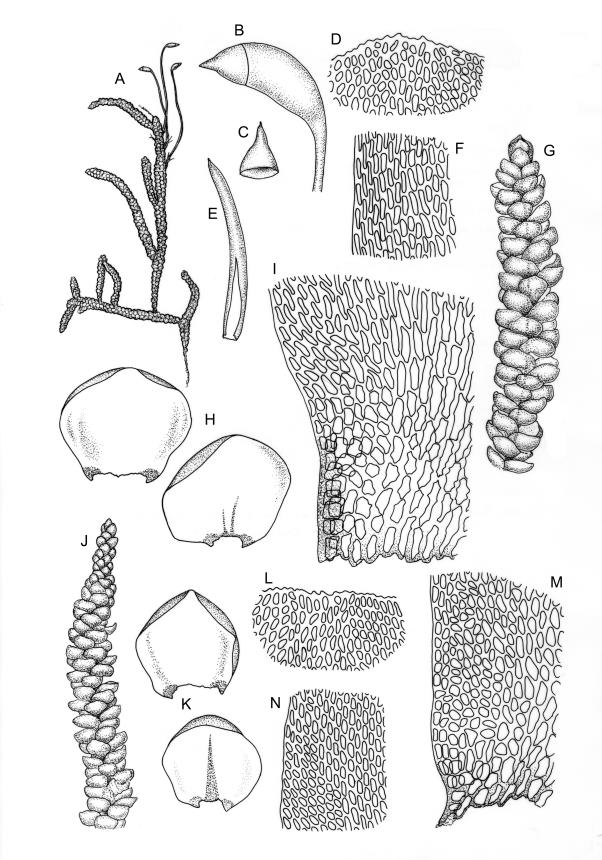
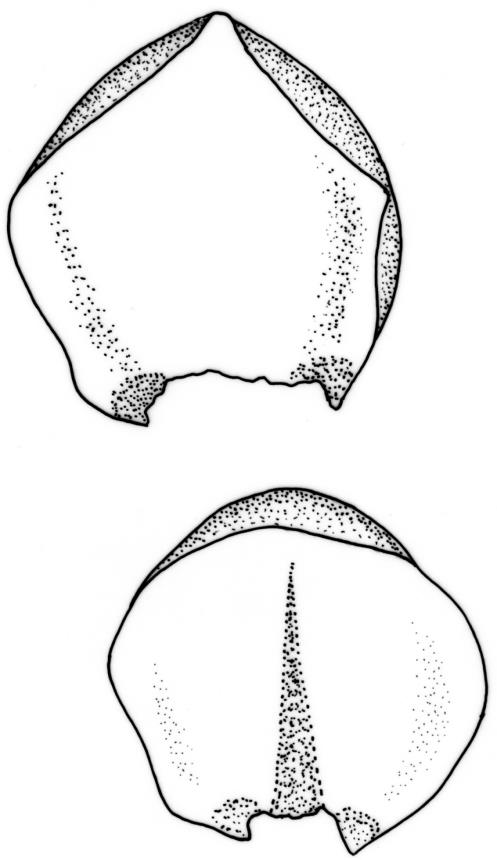
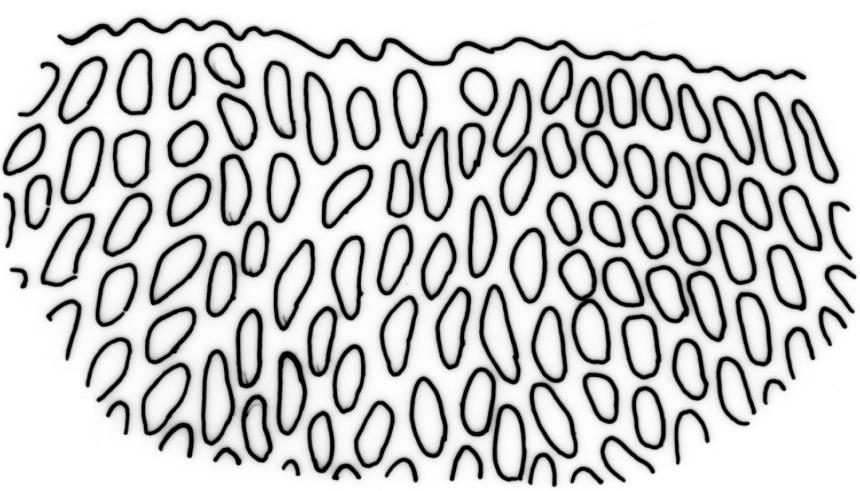
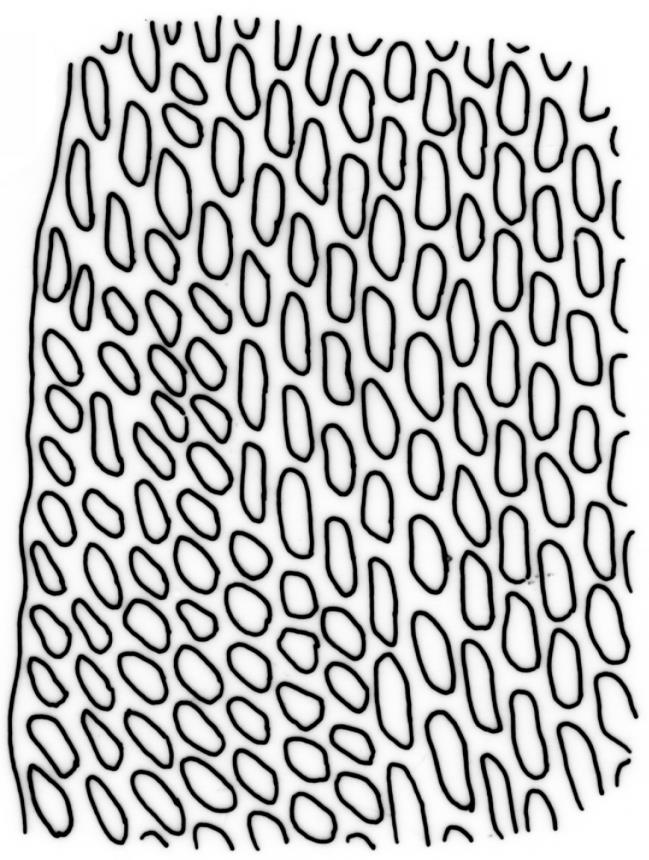
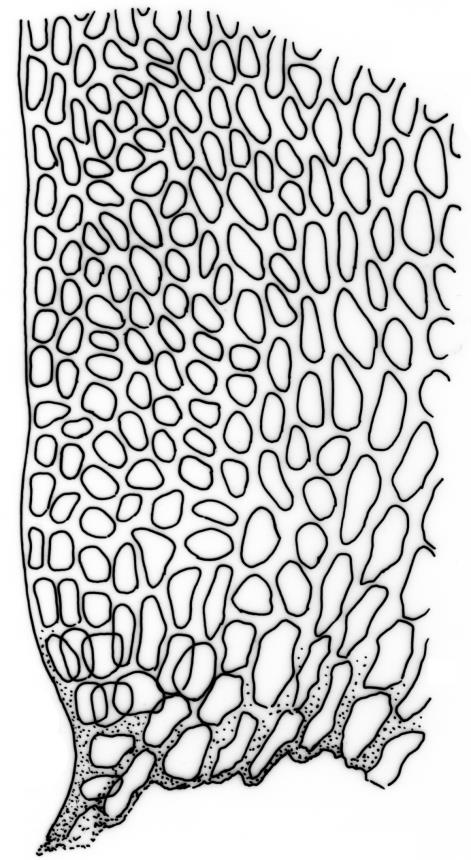
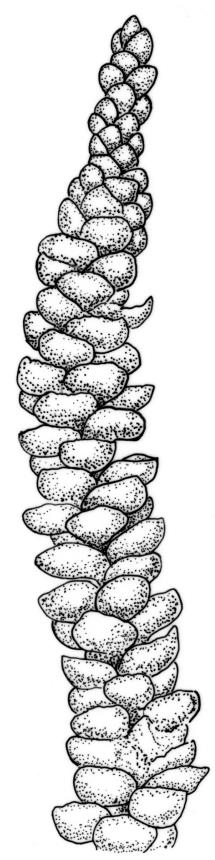
Plants moderately robust to slender, pale, yellow-brown to red-brown or olive green, mostly dull, forming loose wefts on rocks, bark, rotten logs and on the ground. Stems ± erect to scrambling, julaceous to subcomplanate, weakly stipitate, in cross-section c. 360 × 260 µm, with 4–5 layers of cells surrounding a core of parenchyma and an indistinct central strand. Branches blunt, 0.75–0.9 mm wide (including leaves). Pseudoparaphyllia c. 200 × 150 µm. Stem leaves imbricate to occasionally distant, inflated-smooth when moist, mostly unaltered when dry, orbicular to widely ovate, sometimes sub-spathulate, obtuse to widely acute, usually cucullate, deeply concave, 0.8–0.95 (–1.1) × 0.8–1.0 (–1.1) mm, with alar cells irregularly quadrate, porose and forming a group 6–7 cells wide and extending 6–8 cells from the leaf base. Costa variable, single robust and extending to upper lamina, 75–100 µm wide in lowest third, often shorter and divided 2–3 times, sometimes absent. Branch leaves smaller, 0.65–0.85 × 0.65–0.82 mm, with the alar group smaller and similar to the cells of the adjacent basal margin. Mid laminal cells of branch leaves rhombic, sigmoid, not or weakly porose, thick-walled, 6–8 (–9) × 2–2.5 µm, longer and narrower than the adjacent juxta-costal cells, 15–20 (–23) × 5–6 µm, at the apex rhombic to quadrate, 7.5–10 × 5–7.5 µm, marginal cells at mid leaf, 7.5–10 (–12.5) × 5–7.5 µm, extending to the lower margin.
Setae (1.0–) 1.5–2.0 (–2.5) cm. Capsules oblong cylindric, 1.1 × 0.3 mm; exothecial cells irregularly rectangular to quadrate, thick walled, (17–) 20–25 (–30) µm × 17–20 µm. Operculum apiculate, to 0.65 mm. Exostome teeth c. 450–500 µm. Calyptra c. 2 mm. Spores 12–15 µm.
Beever et al. 1992, fig. 65; Tangney 2008, fig. 1.
Lembophyllum divulsum characteristically forms compact mats of elongate, slender julaceous stems and branches. The leaves are mostly unaltered when dry, obtuse to widely acute and cucullate or sometimes erect, deeply concave and cochleariform to subspathulate. L. divulsum has mid laminal cells rhombic and weakly sigmoid and thick-walled, becoming shorter towards the apex and lateral margins and extending towards the basal margin as a zone of non-porose, short, ± quadrate cells. Alar cells are usually not porose and not differentiated from the adjacent basal and marginal cells. The costa is generally single, broad and tapering, extending to the upper leaf, often divided 2–3 times above, sometimes faint, or absent. Smaller plants may be somewhat complanate, with leaves distant so that the stem is visible between the leaves.
NI: Hawke’s Bay, Wellington; SI: Nelson, Marlborough, Canterbury, Otago, Southland (Awarua Bay; Bluff; Lake Manapouri); Ch; A.
Australasian. Tasmania*, mainland Australia (N.S.W.*, A.C.T.*, Vic*, S.A.*), Macquarie I*.
Similar in ecology to L. clandestinum, L. divulsum is a common forest species, occurring on bark, rocks, and rotten logs and on the ground. It is also found in more open habitats, including subalpine shrubland and grassland. In New Zealand it ranges in altitude from sea level on Auckland Island, Stewart Island, coastal Otago and Canterbury to 1470 m on the Arthur Range in Nelson. It is more southern and eastern in distribution compared to L. clandestinum, being absent from N Auckland, S Auckland, Gisborne and Taranaki on the North I., and from Westland on the South I. In Fiordland it is present only on its eastern edge (Lake Manapouri).