Class
Family



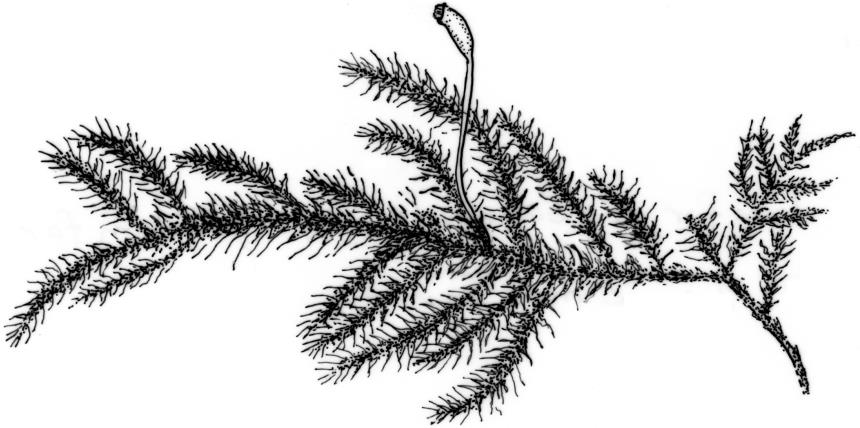
Plants generally robust, mostly rigid, pale or dark, olive-green, dull, forming loose, scrambling wefts on trunks of trees, exposed roots and occasionally on rock. Stems creeping to erect-ascendant, stipitate, sparingly 1(–2)-pinnate, forming mostly irregular fronds, mostly complanate. Branches mostly straight. Pseudoparaphyllia foliose, widely ovate, serrate. Leaves imbricate, erect to erect-spreading, smooth when moist, mostly unaltered when dry, concave, abruptly and long aciculate from a widely ovate-oblong lamina, apex flexuose, ending in uniseriate hair points; margins plane, entire. Costa short and double, faint, failing below mid leaf. Mid laminal cells linear, ± sigmoid, weakly porose, firm-walled, prorate; those above becoming shorter at the upper margins and more elongated centrally, in the subula linear; those below irregularly rectangular and thick-walled. Alar cells more pigmented and forming a triangular group.
Dioicous or pseudautoicous. Inner perichaetial leaves with apices aciculate and flexuose, from an oblong sheathing base. Setae elongate, flexuose, smooth, dark red-brown. Capsules inclined to horizontal, smooth, symmetric or curved, oblong-cylindric, red-brown; exothecial cells irregularly quadrate to hexagonal-isodiametric, firm-walled. Stomata present at the capsule base, superficial. Exostome teeth lanceolate, shouldered, bordered below, pale yellow-brown, outer face closely cross-striate-papillose below and finely to coarsely baculate above, with a zigzag median line; inner face with well-developed lamellae, smooth below, baculate above; endostome pale yellow to hyaline, finely papillose; basal membrane ½–¾ of the height of the exostome and with process keeled, perforate and papillose above. Cilia 2 (–3), well developed, nodulose to appendiculate, papillose. Operculum blunt to short-rostrate from a high conic base, symmetric. Calyptra smooth. Spores spherical, light yellow-brown and sparsely papillose.
Monotypic. A segregate of Camptochaete (Crum 1991), endemic to New Zealand.
Fifea aciphylla combines the unique presence of very long leaf aristae, with a number of features present in the other N.Z. genera in the family.
Originally described as a Camptochaete (Sainsbury 1945); it has rigid and wiry stems, dendroid-stipitate growth, erect stipe leaves and a blunt operculum, all typical of the New Zealand species of Camptochaete (Tangney 1997). It is most similar to C. deflexa in its tidy 1(–2)-pinnate fronds and its neatly arranged imbricate leaves that are little altered when dry, and the original authors considered them to be closely related.
Within the family, Fifea is clearly differentiated from the other Lembophyllaceae, including Camptochaete, by the presence of its remarkable leaf subulae which are longer than the leaf laminae. Crum (1991) removed it from Camptochaete, and he erected Fifea to accommodate it. He emphasised its leaf aristae and very widely ovate stem leaves, with rhombic laminal cells, as being misplaced in Camptochaete.
The stem and stipe leaves of F. aciphylla are unique in N.Z. Lembophyllaceae in being wider than long. The leaves in Lembophyllum are as wide as long, and the other species have leaves longer than wide. The tendency to produce rhombic cells in the stipe leaves approaches the short-rhombic cells of Lembophyllum.
Fifea aciphylla also has well-developed stomata at the capsule base, absent in Camptochaete and otherwise present only in Fallaciella gracilis, and its exothecial cells are irregularly quadrate to hexagonal, rather than shortly oblong as in the other N.Z. Lembophyllaceae.
Fifea combines its unique leaf shape with features of Camptochaete, Lembophyllum and Fallaciella, to produce a combination of morphological characters that supports the recognition of Fifea separate from the other N.Z. genera.
| Category | Number |
|---|---|
| Indigenous (Endemic) | 1 |
| Total | 1 |