


Classification
 Nomenclature
Scientific Name:
Fallaciella gracilis (Hook.f. & Wilson) H.A.Crum, J. Hattori Bot. Lab. 69: 320 (1991)
Synonymy:
  • Hypnum gracile Hook.f. & Wilson, London J. Bot. 3: 553 (1844) nom. illeg., non Hypnum gracile (Hedw.) With. 1801
  • Isothecium gracile Hook.f. & Wilson in Wilson, Bot. Antarct. Voy. II (Fl. Nov.-Zel.) Part II, 106 (1854)
  • Stereodon gracilis (Hook.f. & Wilson) Mitt., J. Proc. Linn. Soc., Bot. 4: 88 (1859)
  • Microthamnium gracile (Hook.f. & Wilson) A.Jaeger, Ber. Thätigk. St. Gallischen Naturwiss. Ges. 1876–1877: 426 (1878)
  • Porotrichum gracile (Hook.f. & Wilson) Mitt., Trans. & Proc. Roy. Soc. Victoria 19: 84 (1882)
  • Ptilocladus gracilis (Hook.f. & Wlson) Lindb. in Paris, Index. Bryol. 234 (1894) nom. illeg.
  • Camptochaete gracilis (Hook.f. & Wilson) Paris, Index. Bryol. 234 (1894)
  • Thamnium gracile (Hook.f. & Wilson) Kindb., Hedwigia 41: 255 (1902)
Holotype: N.Z., South Island, Otago, J. Buchanan (Herb. Gourlie), BM!
  • = Hypnum microvagum Beckett, Trans. & Proc. New Zealand Inst. 26: 275 (1894) – as micro-vagum
  • Lembophyllum microvagum (Beckett) Beckett, Trans. & Proc. New Zealand Inst. 29: 444 (1896) – as Lembophyllum micro-vagum
Lectotype: N.Z., South Island, Ben More, North Canterbury, T.W.N. Beckett 366, CHR 539613! (Designated by Tangney & Fife 2003, p. 124.)
  • = Camptochaete tasmanica Broth. in Rodway, Pap. & Proc. Roy. Soc. Tasmania 1913: 229 (1914)
Holotype: Australia, Tasmania, Western Tiers, Rodway 19/1912, H-BR 2531! Probable isotype: WELT M10747!
  • = Taxithelium novae-zealandiae E.B.Bartram & Dixon, Bot. Not. 1937: 83 (1937)
  • Camptochaete novae-zeelandiae (E.B.Bartram & Dixon) P.E.A.S.Câmara, Novon 20: 139 (2010)
Holotype: N.Z., Wellington, S. Berggren 1874, 550 (p.p.), BM 000850512!
Etymology:
The epithet means slender.
 Description

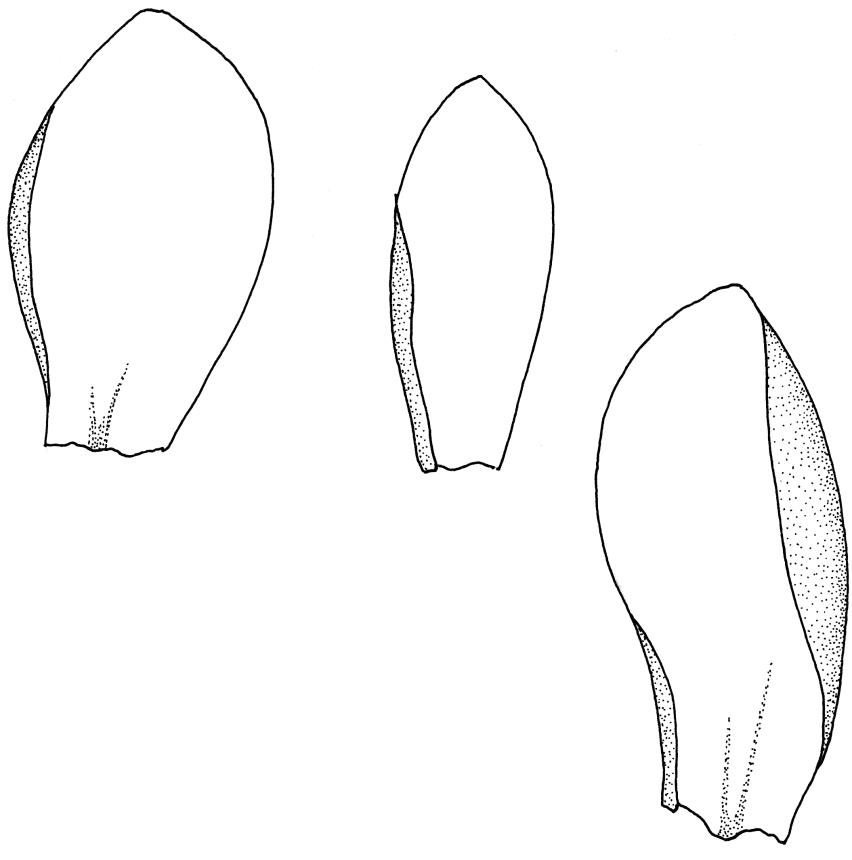
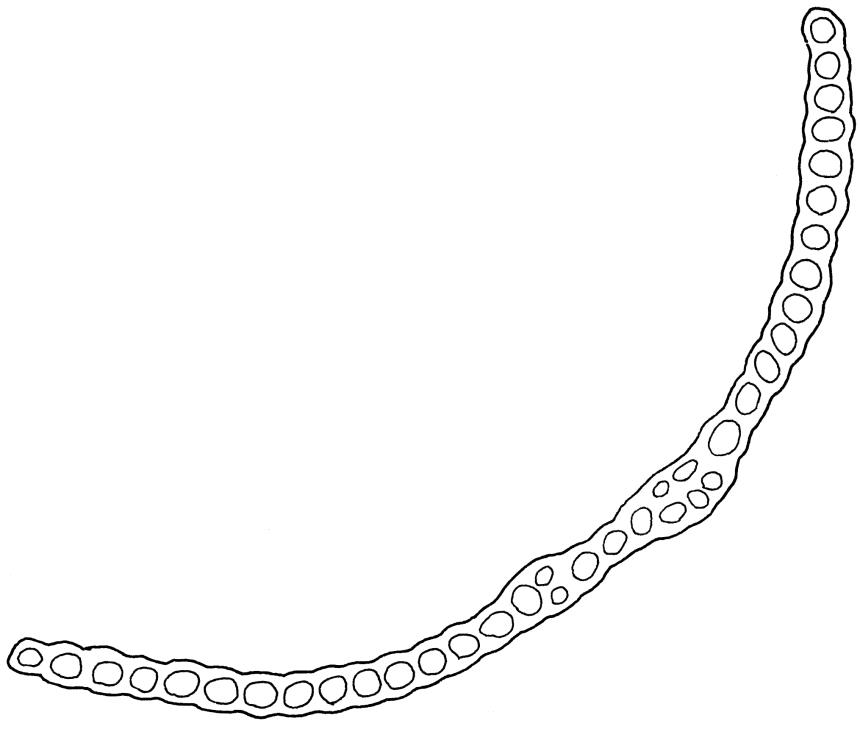
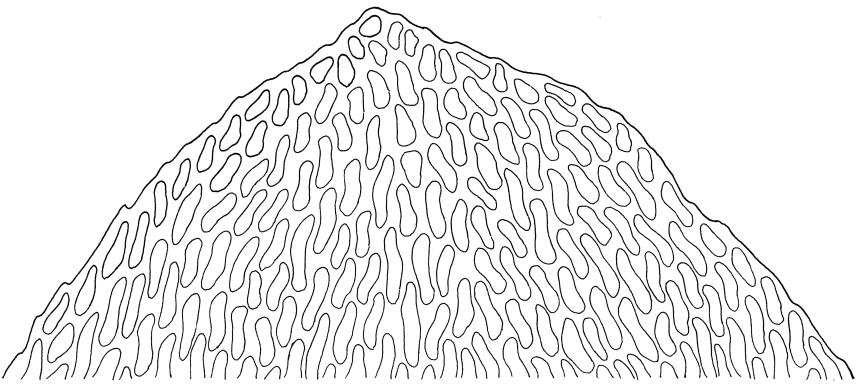
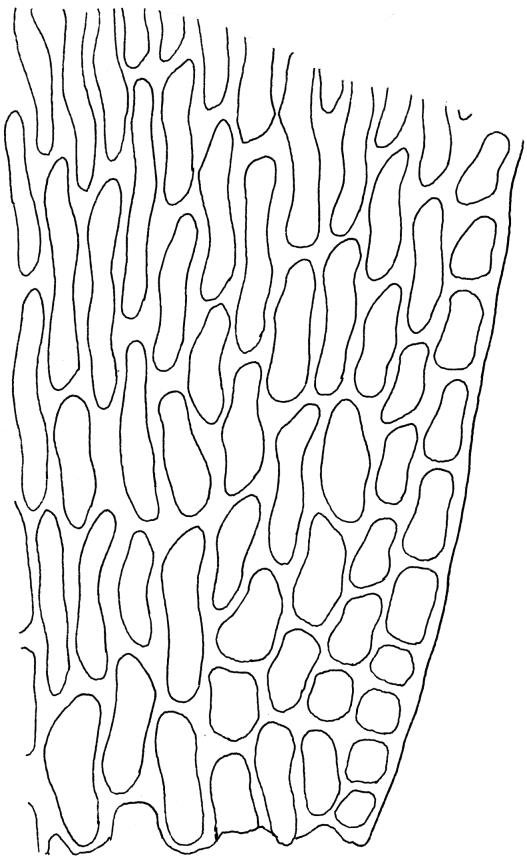
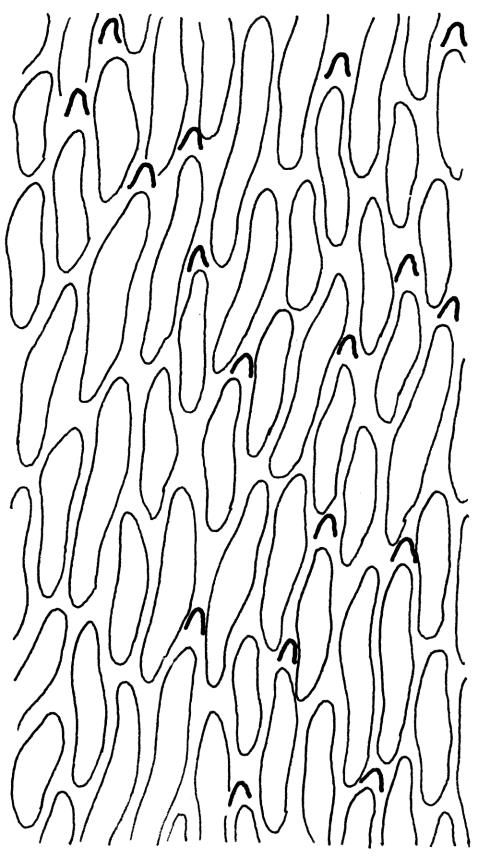
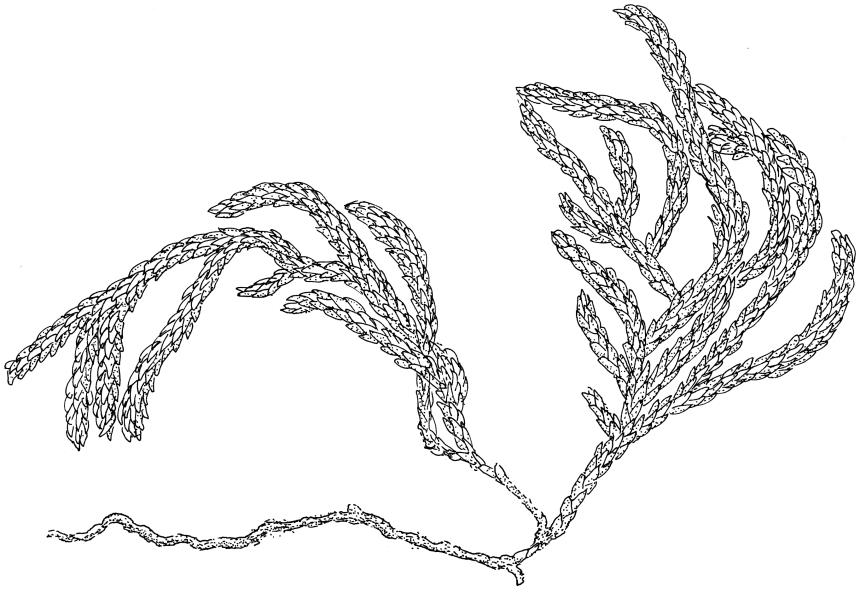
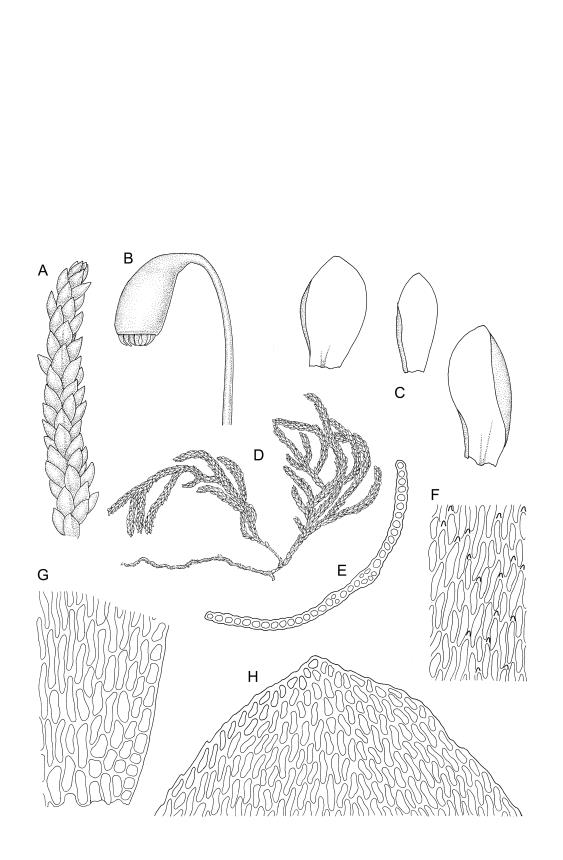
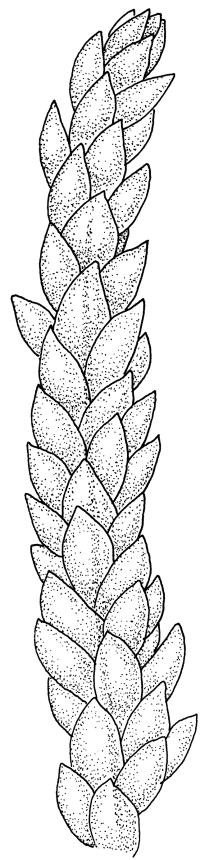
Plants slender, dull or slightly glossy, usually forming tightly appressed mats on rocks or bark. Stems usually creeping and forming ± irregular but mostly pinnate fronds; in cross-section c. 210 × 250 mm, with an outer layer of 4–5 cells surrounding an inner core of parenchyma, with no central strand. Branches 0.4–0.6 mm wide. Pseudoparaphyllia c. 110 µm long. Stem leaves usually homomallous, inflated-smooth and weakly concave when moist, little altered when dry, ovate to elliptic, obtuse to widely acute, 0.75–1.1 × 0.5–0.6 mm, at the margins mostly plane (sometimes weakly incurved above or weakly revolute below) and serrulate above, with alar cells ± quadrate, pigmented, and forming a group c. 6–8 cells wide and extending c. 10 (–13) cells from the leaf base. Branch leaves smaller than stem leaves, usually homomallous, blunt and lacking an apiculus, 0.45–0.8 mm, with a smaller alar group. Mid laminal cells prorate to prorate-papillose, (18–) 24–36 × 4–6 µm, those at apex rhombic or ± irregular, c. 9–12 µm long.
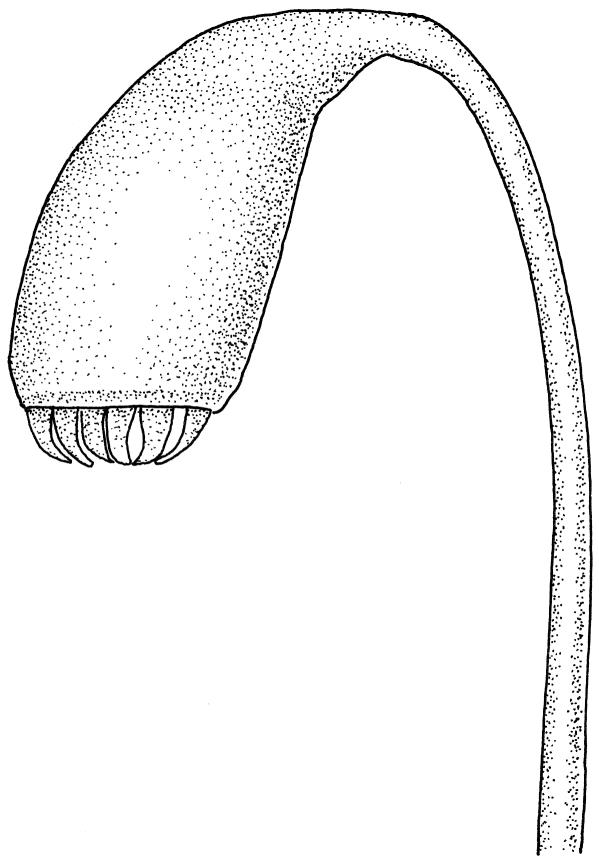
Dioicous. Setae c. 12–20 mm, weakly twisted to the left. Capsules c. 1.5–1.8 mm long; exothecial cells 25–45 × 12–17 µm. Operculum highly variable, apiculate or short-rostrate from a high conic base, asymmetric or symmetric, c. 0.35–0.5 mm. Calyptra c. 2 mm. Spores 12–15 µm.

 Recognition

Fallaciella gracilis is a distinctive plant not readily confused with other species. The plants are small and form pale, tightly attached, olive green to brown mats with narrow stems and branches. Amongst the N.Z. Lembophyllaceae, it is the only species that produces tightly attached mats. This distinctive feature is, however, underlain by the same branching architecture that is shared by the other genera and is typical for the family (Tangney 1998). This feature is somewhat obscured by the plant size, but it is observable across a range of material.
The plants are soft, compared to the larger tough and wiry plants of Camptochaete. Fallaciella gracilis also differs from Camptochaete in having its leaves dull and little altered when dry, and only slightly concave when moist, with the upper margins plane. The leaf apex is usually widely acute and lacks an apiculus. In other N.Z. Lembophyllaceae the leaves are typically semi glossy and greener, only occasionally brown, more deeply concave, and with the upper margins typically incurved. Unusually for the family, F. gracilis often produces papillae on the distal cell prorae. The presence of leaf prorae is common in Camptochaete and in other Lembophyllaceae, where they are present as slight protrusions of the cell ends, but in Fallaciella gracilis they are marked, and are sometimes visible protruding from the backs of leaves.
Fallaciella gracilis is a smaller, more tightly attached and often duller plant than F. robusta, which tends to be larger, more loosely attached and with glossier leaves. Fallaciella gracilis is a finer plant with slender stems and branches, and leaves little altered when dry, typically ovate, slightly concave when moist, with the upper margins plane, and the apex is usually broadly acute. F. robusta has leaves more deeply concave with upper margins incurved and an apiculus which is often recurved. In addition, prorae of the mid-laminal cells of the branch leaves are frequently papillose in F. gracilis, whereas the prorae of F. robusta are smooth.

 Distribution

NI: N Auckland, including offshore islands (LB, GB), S Auckland, Gisborne, Taranaki (Taranaki Maunga), Wellington; SI: Nelson, Marlborough, Canterbury, Westland, Otago, Southland; St; Ch; A; C.
Austral. Tasmania*, mainland Australia* (Qld, N.S.W., A.C.T., Vic.), Chile*.

 Habitat

Relatively common in forested stream beds, where it is found mainly on rocks and exposed tree roots, occasionally on damp earth. It is also found on the same substrates in more open and upper elevation habitats, including subalpine scrub and more rarely on soil in subalpine grasslands. It occurs from sea level to c. 1430 m on the South I. (Temple Basin, Arthur’s Pass, Canterbury L.D.), and to nearly 1300 m on the North I. (Taranaki Maunga and the Tararua Range).

 Biostatus
Indigenous (Non-endemic)
 Notes

The type material of Isothecium gracile in BM (J. Buchanan (in herb. Gourlie), comprises a number of specimens (BM 000850985 to BM 000850993 inclusive. A lectotype has not been selected.
 Images
 Bibliography
Beckett, T.W.N. 1894 ("1893"): On four new species of New Zealand Musci. Transactions and Proceedings of the New Zealand Institute 26: 274–277.
Beckett, T.W.N. 1897 ("1896"): On New Zealand mosses. Transactions and Proceedings of the New Zealand Institute 29: 441–445.
Câmara, P.E.A.S. 2010: New combinations and one new name for the moss genus Taxithelium (Pylaisiadelphaceae). Novon 20(2): 139–142.
Crum, H.A. 1991: A partial clarification of the Lembophyllaceae. Journal of the Hattori Botanical Laboratory 69: 313–322.
Dixon, H.N. 1927: Studies in the bryology of New Zealand, with special reference to the herbarium of Robert Brown. Part V. Bulletin, New Zealand Institute 3(5): 239–298. [as Camptochaete gracilis (Hook.f. & Wilson) Paris; Hypnum microvagum Beckett]
Dixon, H.N.; Bartram, E.B. 1937: S. Berggren's New Zealand mosses. Botaniska Notiser 1937: 63–84.
Fife, A.J. 1995: Checklist of the mosses of New Zealand. Bryologist 98: 313–337.
Hooker, J.D.; Wilson, W. 1844: Musci Antarctici; being characters with brief descriptions of the new species of mosses discovered during the voyage of H.M. Discovery ships, Erebus and Terror, in the southern circumpolar regions, together with those of Tasmania and New Zealand. London Journal of Botany 3: 533–556. [Oct. 1844]
Jaeger, A. 1878: Genera et species muscorum systematice disposita seu adumbratio florae muscorum totius orbis terrarum (continuatio) [Pars VIII]. Bericht über die Thätigkeit der St. Gallischen Naturwissenschaftlichen Gesellschaft 1876–1877: 211–454. [More commonly available in the "Separatabdruck" of the same title: 1870–1879: 2 vols.]
Kindberg, N.C. 1902: Grundzüge einer Mongraphie der Laubmoosgattung Thamnium. Hedwigia 41: 203–268.
Mitten, W. 1859 ("1860"): Description of some new species of Musci from New Zealand and other parts of the southern hemisphere, together with an enumeration of the species collected in Tasmania by William Archer Esq.; arranged upon the plan proposed in the "Musci Indiae Orientalis". Journal of the Proceedings of the Linnean Society. Botany 4: 64–100.
Mitten, W. 1882: Australian mosses, enumerated by William Mitten, Esq. Transactions and Proceedings of the Royal Society of Victoria 19: 49–96.
Paris, E.G. 1894–1898: Index Bryologicus sive enumeratio muscorum hucusque cognitorum adjunctis synonymia distributioneque geographica locupletissimis. Klincksieck, Bordeaux.
Rodway, L. 1914: Tasmanian Bryophyta Part III. Papers and Proceedings of the Royal Society of Tasmania 1913: 177–263.
Sainsbury, G.O.K. 1955: A handbook of the New Zealand mosses. Bulletin of the Royal Society of New Zealand 5: 1–490. [as Camptochaete gracilis (Hook.f. & Wilson) Paris; Taxithelium novae-zealandiae E.B.Bartram & Dixon]
Tangney, R.S. 1997: A generic revision of the Lembophyllaceae. Journal of the Hattori Botanical Laboratory 81: 123–153.
Tangney, R.S. 1998: The architecture of the Lembophyllaceae (Musci). Journal of the Hattori Botanical Laboratory 84: 37–47.
Tangney, R.S. 2026: Lembophyllaceae. In: Glenny, D. (ed.) Flora of New Zealand — Mosses. Fascicle 51. Manaaki Whenua Press, Lincoln.
Tangney, R.S.; Fife, A.J. 2003: A review of the genus Fallaciella (Bryopsida: Lembophyllaceae) including a new species from South Island, New Zealand. Journal of Bryology 25: 121–128.
Wijk, R. van der; Margadant, W.D.; Florschütz, P.A. 1964: Index Muscorum. Vol. 3. International Bureau for Plant Taxonomy and Nomenclature, Utrecht. [as Camptochaete gracilis (Hook.f. & Wilson) Paris; Lembophyllum microvagum (Beckett) Beckett]
Wilson, W. 1854 ("1855"): Musci. In: Hooker, J.D. The Botany of the Antarctic Voyage of H.M. Discovery Ships Erebus and Terror, in the years 1839–1843, under the command of Captain Sir James Clark Ross. II. Flora Novae-Zelandiae. Part II. Flowerless plants. Lovell Reeve, London. 57–125.